
Dr. Jorge Vives, medico radiologo y medico estetico en Cartagena
Diagnostic study · Cartagena, Medellín and Bogotá

Kidney and Bladder Ultrasound in Colombia

Dr. Jorge Vives is a radiologist: he checks the kidneys, the bladder and the prostate in one study, measures how much urine is left after you go, and explains the result in the same visit. Come with a full bladder — that is the only preparation you need.

Radiologist

Specialist, Universidad de Cartagena

Since 2014

Dedicated to ultrasound and Doppler

Same day

Report explained during the visit

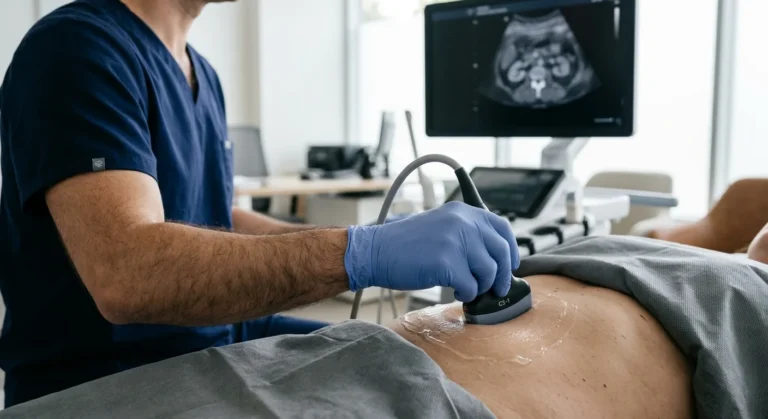
Male radiologist performing a kidney and bladder ultrasound on a patient's lower abdomen

Same-day report

Explained to you in the same visit

  • ACR member
  • CMAC Expert Committee
  • International Speaker
  • Degree recognized in Spain
  • Radiologist + Aesthetic Physician

What is a kidney and bladder ultrasound?

It is an ultrasound study of the whole urinary tract: both kidneys, the bladder and, in men, the prostate. It uses no radiation, needs no needles and does not hurt.

It answers very concrete questions. Whether there are stones and how big they are. Whether a kidney is swollen because something is blocking the flow of urine. How the bladder wall looks. And how much urine is left inside after you go, which is a number no blood test gives and which matters a lot when emptying is difficult.

In men the size of the prostate is also measured, and that is usually what explains getting up several times at night or feeling that the bladder never empties.

Dr. Jorge Vives performing a kidney and bladder ultrasound with a curved probe on the abdomen

Six things worth knowing beforehand

What patients usually want to know before they book.

Come with a full bladder

It is the only preparation. Without it the study loses information.

No radiation

It is ultrasound: no X-rays and no contrast agent.

20 to 30 minutes

Kidneys, bladder and prostate in a single visit.

Two halves

You are scanned with a full bladder and again after you go to the bathroom.

It measures what is left

How much urine stays inside after you go, in milliliters.

Dr. Vives reads it

The same radiologist who takes the images writes the report.

When is this study recommended?

It is usually the first study when something in the urinary tract is not right. It is quick, it does not irradiate, and it answers most of the opening questions.

Pain in the lower back or the side

Renal colic is the most common reason patients come in.

Blood in the urine

Even if it happened only once, the kidneys and bladder should be looked at.

Repeated urinary infections

To rule out something that may be making them easier to get.

Trouble passing urine

A weak stream, urgency, getting up at night, or feeling you never empty.

Follow-up of known stones

To see whether they are still there, whether they moved, or whether they grew.

An abnormal creatinine

When blood work suggests the kidneys should be checked.

Your visit, step by step

Two halves in one visit: with a full bladder, and again after you empty it.

1

You arrive with a full bladder

This is the part that depends on you. A full bladder pushes the structures apart and lets its wall — and, in men, the prostate — be seen properly.
2

Kidneys and bladder

Warm gel is applied and Dr. Vives goes over the flanks and the lower abdomen. Both kidneys are measured and checked for stones or swelling.
3

You go to the bathroom

The study pauses so that you can go normally.
4

What is left behind

The bladder is measured again to work out how much urine stayed inside. The images are read on the spot and you leave with your report.

How to prepare, in practice

This is the one study in this line that needs preparation, and it is simple. Much of what can be seen depends on it.

1 hour before

Drink four to six glasses of water.

Do not use the bathroom

Until the first half of the study is over.

No fasting

Eat normally and take your usual medication.

If you arrive with a lot of urgency, tell us. The part that needs a full bladder can be brought forward. And if you could not hold it and went, you wait in the office until it fills again: you do not lose your appointment.

What is checked

What the study covers,
part by part

The study covers the whole urinary tract and measures something no blood test gives: how much urine is left in the bladder after you go.

Kidney ultrasound, long-axis view, with the brighter central renal sinus

A kidney in long-axis view. Its size and tissue are measured, and it is checked for stones or swelling.

What you leave the visit with

  • The size and appearance of both kidneys, with any stones or cysts found.
  • The state of the bladder and the post-void residual in milliliters.
  • The volume of the prostate, in men.
  • A written report in digital format, ready for your urologist.
Kidneys

Size, shape and tissue thickness. Stones, cysts, and whether a blockage is causing swelling.

Bladder

Wall thickness and appearance, stones inside it, and its contents.

Post-void residual

How much urine is left after you go, in milliliters. It guides the work-up when emptying is difficult.

Prostate

In men: volume and structure, which explain much of what is felt in the urinary tract.

What this study does not settle. The ureters are poorly seen on ultrasound along much of their length, so a stone lodged there can go unnoticed. If symptoms continue and the ultrasound is normal, your treating physician is the one who decides whether a CT scan is needed. And a prostate ultrasound is not the cancer screening test: that is decided by PSA and your urologist.

If you are traveling from outside Colombia

You can book before you travel and get the whole study done in one appointment.

  • Book from abroad through the form on this page, with no intermediaries.
  • Your report the same day, so you do not need a second trip.
  • Time the water around your appointment: you need to arrive with a full bladder, and that is hard to improvise if you are coming straight from the airport.
  • Bring your blood tests and any previous kidney study.

Where he practices

Three cities, one schedule

Permanent office

Cartagena

CC Bocagrande, Carrera 2 #8-142, floor 2, office 218.

Scheduled dates

Bogotá

In medical cowork spaces. The address is confirmed when you book.

Scheduled dates

Medellín

In medical cowork spaces. The address is confirmed when you book.

Dr. Jorge Vives, radiologist and aesthetic physician, Cartagena

Dr. Jorge Vives Gutiérrez

Dr. Jorge Vives is a radiologist, a specialist from the Universidad de Cartagena with his degree recognized in Spain. He has worked with ultrasound, Doppler and ultrasound-guided procedures since 2014.

Book your kidney and bladder ultrasound

Tell us what is going on and whether you have a referral, and we will confirm the available dates in Cartagena, Medellín or Bogotá.

Dr. Jorge Vives office at Bocagrande Shopping Center, Cra. 2 #8-142, 2nd floor, Office 218, Cartagena, Colombia
ULTRASOUND (EN)

Frequently asked questions about kidney and bladder ultrasound

What patients ask most before their study.

How much does the study cost?

It depends on whether the whole urinary tract is studied or only part of it, and on whether Doppler is needed. Send us your referral through the form on this page and we will confirm the cost and the payment options.

You need a full bladder. The usual advice is four to six glasses of water about an hour before your appointment, and no bathroom until the first half of the study is over. If you feel a lot of urgency when you arrive, tell us: that part can be brought forward.

You can wait in the office until the bladder fills again, so you do not lose your appointment. It does make the visit longer, which is why it helps to time the water around your slot.

There is no radiation and it does not hurt. The only real discomfort is having a full bladder during the first half of the study.

Not all of them. It is good at stones inside the kidney and in the bladder, but stones sitting halfway down the ureter can be hidden because the bowel gets in the way. When the suspicion stays and the ultrasound is normal, the study that settles it is a CT scan, and your doctor is the one who orders that.

It measures its size and shows its structure, and that is what explains much of what men feel in the urinary tract. It is not a screening test for prostate cancer; your urologist decides on that with your PSA.

Yes. A referral for a renal, urinary tract or bladder and prostate ultrasound is valid here. Bring it: it says what your doctor was looking for, and that shapes the study. There are no known risks from the scan itself and it is not contraindicated in pregnancy; tell us when you book if you have a catheter or a recent operation on the abdomen.