Breast Ultrasound with BI-RADS in Colombia
Dr. Jorge Vives is a radiologist: he studies the breast tissue with ultrasound, classifies what he finds with BI-RADS and explains what that category means before you leave the office. It is a study that complements mammography, not a replacement for it.
Radiologist
Specialist, Universidad de Cartagena
Since 2014
Dedicated to ultrasound and Doppler
Same day
Report explained during the visit
Same-day report
Explained to you in the same visit
- ACR member
- CMAC Expert Committee
- International Speaker
- Degree recognized in Spain
- Radiologist + Aesthetic Physician
- WHAT THE STUDY IS
What is a breast ultrasound?
It is an ultrasound study of the breast tissue, with no radiation and no compression. It is used above all for two things: telling whether a nodule is solid or filled with fluid, and studying dense breasts, where mammography has a harder time seeing.
The first one matters more than it sounds. Many of the nodules that turn up are cysts — pockets of fluid — and ultrasound identifies them very clearly. Knowing that in the same visit changes entirely how a patient goes home.
And it is worth saying plainly: this study does not replace mammography. They see different things and they complement each other. Your doctor decides which one you need and when.
- THE ESSENTIALS
Six things worth knowing beforehand
What patients usually want to know before they book.
No radiation
It is ultrasound: no X-rays and no contrast agent.
No compression
The breast is not pressed the way it is for a mammogram.
No preparation
No fasting and no medication to stop.
15 to 20 minutes
Both breasts and the underarms in a single visit.
BI-RADS classification
The international standard, explained during the visit.
Dr. Vives reads it
The same radiologist who takes the images writes the report.
- WHEN IT IS RECOMMENDED
When is a breast ultrasound recommended?
Almost always for a specific finding, or as a complement to another study. Your doctor is the one who decides whether you need it and when.
A lump you felt yourself
To find out whether it is solid or a cyst filled with fluid.
Dense breast tissue
Where mammography sees with more difficulty and ultrasound adds information.
Clarifying a finding
When a mammogram showed something that needs characterizing.
Pain in one spot
In one specific place that will not settle.
Follow-up of a known nodule
Comparing against the previous study shows whether it changed.
Breast implants
To check that they are intact and to look at the tissue around them.
- HOW IT WORKS
Your visit, step by step
One visit, with no preparation and no compression.
You say what worries you
Both breasts examined
BI-RADS classification
The result explained
BI-RADS classification
What does the BI-RADS
in your report mean?
BI-RADS is the system from the American College of Radiology for classifying what is found in a breast study. It is not a severity score: it is a category that says what to do next.
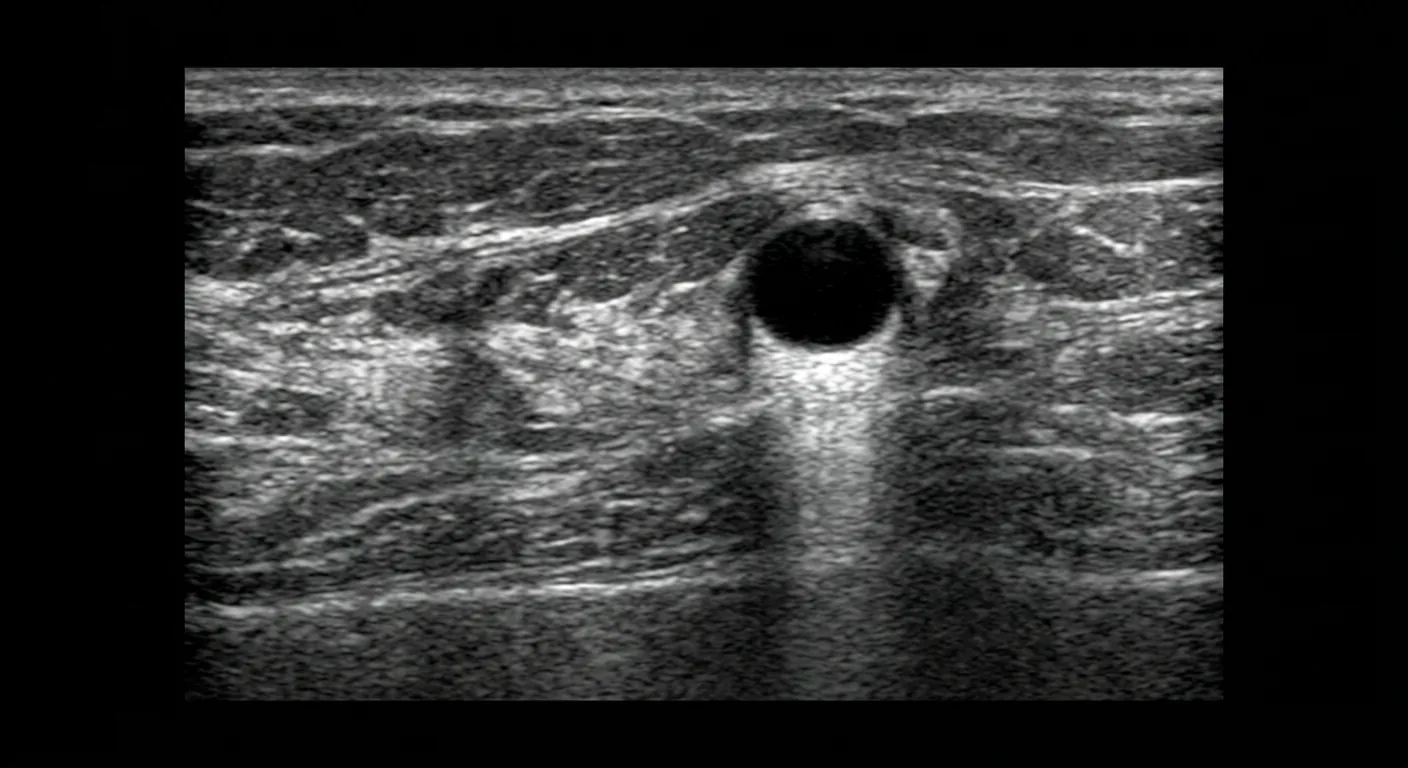
A simple cyst: round, dark and sharply outlined. Ultrasound tells these apart clearly.
What you leave the visit with
- The study of both breasts and the underarms, with a measurement for each finding.
- Tu BI-RADS category explained, not just written on the page.
- A written report in digital format, ready for your treating physician.
- The next step: follow-up, biopsy or nothing.
A normal study. Nothing to report.
A benign finding, such as a simple cyst. Nothing further is needed.
Probably benign: fewer than 2% turn out to be malignant. It is followed up at 6 months.
Suspicious. A biopsy is advised to find out what it is. It has subcategories a, b and c.
Highly suggestive. A biopsy and prompt assessment are advised.
The 0 and the 6 are missing, and it is worth knowing why. BI-RADS 0 means the study is incomplete and more images are needed; BI-RADS 6 is used when a biopsy has already confirmed the diagnosis. And above all: a category is not a diagnosis. It guides what happens next, and your treating physician decides that, with your whole case in front of them.
- FROM ANOTHER COUNTRY
If you are traveling from outside Colombia
You can book before you travel and get the whole study done in one appointment.
- Book from abroad through the form on this page, with no intermediaries.
- Your report the same day, so you do not need a second trip.
- Bring your earlier studies, including your mammogram if you have one: without something to compare against, no one can say whether a finding has changed, and that is half the value of the study.
Where he practices
Three cities, one schedule
Permanent office
Cartagena
CC Bocagrande, Carrera 2 #8-142, floor 2, office 218.
Scheduled dates
Bogotá
In medical cowork spaces. The address is confirmed when you book.
Scheduled dates
Medellín
In medical cowork spaces. The address is confirmed when you book.
- ABOUT THE SPECIALIST
Dr. Jorge Vives Gutiérrez
- Universidad de Cartagena
- Degree recognized in Spain
- Speaker at international congresses
- Colombian board-certified radiologist — ACR member
- Member of the CMAC and AAAM expert committees
- International speaker for the Colombian Association of Radiology
- Pioneer of ultrasound-guided facial fillers in Colombia
- Faculty: Course on Ultrasound and Intervention in Facial Aesthetics
- BOOKING
Book your breast ultrasound
Tell us what worries you and whether you have a referral or earlier studies, and we will confirm the available dates in Cartagena, Medellín or Bogotá.
- FREQUENTLY ASKED QUESTIONS
Frequently asked questions about breast ultrasound
What patients ask most before their study.
How much does a breast ultrasound cost?
It depends on whether both breasts and the underarms are studied, and on whether Doppler is needed. Send us your referral through the form on this page and we will confirm the cost and the payment options.
Does an ultrasound replace a mammogram?
No. A mammogram detects microcalcifications that an ultrasound does not show, and an ultrasound tells cysts from solid nodules and works better in dense breasts. One does not cover for the other, and which you need — and when — is a decision for your doctor.
My result says BI-RADS 3. Should I worry?
BI-RADS 3 means “probably benign”: according to the American College of Radiology, fewer than 2% of these findings turn out to be malignant. What is advised is not a biopsy but a follow-up scan at six months to confirm that it does not change. It is a category for watching, not for alarm, and it is worth discussing with your doctor.
Do I need any preparation?
No. No fasting and no medication to stop. If you can, come without talc, cream or deodorant on the area, since they can interfere with the gel.
Does it hurt? Will my breast be compressed?
No and no. Unlike a mammogram, there is no compression here: only the probe sliding over the skin with gel. If an area is sore, it is examined more gently.
Is it useful if I have implants?
Yes. Ultrasound can check that the implant is intact and look at the tissue around it, and it is a routine study in follow-up. Tell us when you book so the right amount of time is set aside.
What are the risks, and can I use my referral?
There are no known risks: no radiation, no compression, nothing injected, and it is not contraindicated in pregnancy or while breastfeeding. Tell us when you book if the skin over the area is broken or dressed, since the probe has to touch it. And yes: a referral for a breast or bilateral breast ultrasound is valid here — bring it with your earlier studies, because it says what your doctor was looking for.