
Abdominal Ultrasound in Colombia
Dr. Jorge Vives is a radiologist: he checks the liver, gallbladder, pancreas, spleen, kidneys and the aorta in one study, and explains the result in the same visit. Come fasting for six to eight hours — it is the only preparation, and without it the gallbladder cannot be assessed.
Radiologist
Specialist, Universidad de Cartagena
Since 2014
Dedicated to ultrasound and Doppler
Same day
Report explained during the visit
Same-day report
Explained to you in the same visit
- ACR member
- CMAC Expert Committee
- International Speaker
- Degree recognized in Spain
- Radiologist + Aesthetic Physician
- WHAT THE STUDY IS
What is an abdominal ultrasound?
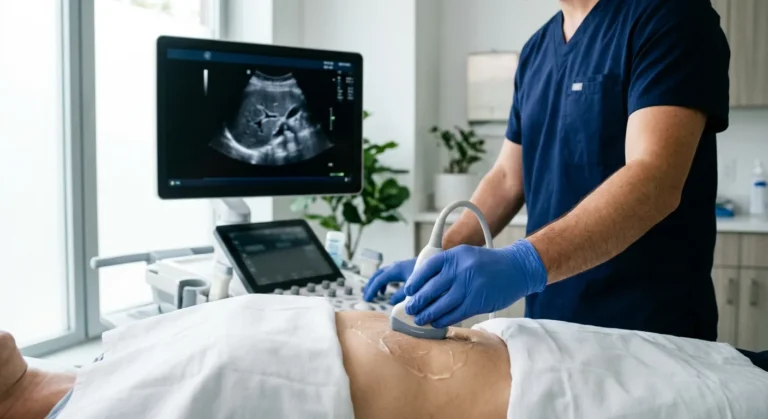
It is an ultrasound study that looks at the organs of the abdomen in one go: the liver, the gallbladder and bile ducts, the pancreas, the spleen, both kidneys and the large vessels, including the aorta. It uses no radiation, needs no needles and does not hurt.
It answers a lot for what it costs: one visit shows whether fat has built up in the liver, whether there are stones in the gallbladder, whether a kidney is swollen, and whether the aorta is a normal caliber. That is why it is usually the first study asked for when abdominal pain has no clear cause.
Its limit is worth knowing too: gas in the bowel blocks what sits behind it, so the pancreas is not always seen in full. The fast exists precisely to reduce that gas and to let the gallbladder fill so it can be judged.
- THE ESSENTIALS
Six things worth knowing beforehand
What patients usually want to know before they book.
Come fasting
Six to eight hours. It is the only preparation, and it decides whether the study works.
No radiation
It is ultrasound: no X-rays and no contrast agent.
20 to 30 minutes
Six organs and the large vessels in a single visit.
Six organs, one study
Liver, gallbladder, pancreas, spleen, kidneys and aorta.
Same-day report
With the finding explained, not by phone days later.
Dr. Vives reads it
The same radiologist who takes the images writes the report.
- WHEN IT IS RECOMMENDED
When is an abdominal ultrasound recommended?
It is usually the first study when something in the abdomen is not right, and also the one asked for to follow up a finding that is already known.
Abdominal pain with no clear cause
Especially in the upper abdomen and on the right side.
Suspected gallstones
Pain after fatty meals, with nausea.
Fatty liver
To see how much fat there is and follow how it changes.
Abnormal liver tests
Transaminases or bilirubin out of range.
Follow-up of a known cyst
Comparing against the previous study shows whether it grew.
A check of the aorta
To measure its caliber, especially when there are risk factors.
- HOW IT WORKS
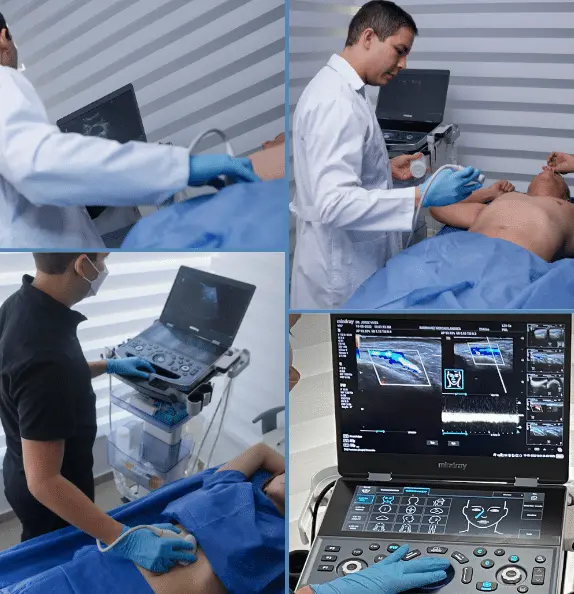
Your visit, step by step
One visit. The only part that depends on you is arriving fasted.
You arrive fasting
Organ by organ
Everything found is measured
The result explained
What is checked
What the study covers,
organ by organ
Six organs and the large vessels in one examination. Here is what gets assessed in each, and what tends to turn up.

Liver in long-axis view. Its size, its texture and any build-up of fat are assessed.
What you leave the visit with
- The state of the six organs, with a measurement for each finding.
- Whether there is fatty liver and how much of it can be seen.
- A written report in digital format, ready for your treating physician.
- The next step: follow-up, another study or nothing.
Size, texture and any build-up of fat. This is where the study gives most.
Stones, wall thickness and whether the ducts are dilated. This part needs the fast.
Size and structure. Bowel gas can hide part of the pancreas.
Size, cysts, stones and whether a blockage is causing swelling.
The caliber of the abdominal aorta, which is how a dilation gets ruled out.
What this study does not settle. Bowel gas limits what can be seen, above all in the pancreas, and that is written in the report when it happens. An ultrasound describes what is there; your treating physician is the one who decides whether a CT or an MRI is needed.
- FROM ANOTHER COUNTRY
If you are traveling from outside Colombia
You can book before you travel and get the whole study done in one appointment.
- Book from abroad through the form on this page, with no intermediaries.
- Your report the same day, so you do not need a second trip.
- Time the fast around your appointment: six to eight hours without food is hard to improvise if you come straight from the airport.
- Bring any previous ultrasound or CT of the abdomen: comparing is the only way to show whether a finding has changed.
Where he practices
Three cities, one schedule
Permanent office
Cartagena
CC Bocagrande, Carrera 2 #8-142, floor 2, office 218.
Scheduled dates
Bogotá
In medical cowork spaces. The address is confirmed when you book.
Scheduled dates
Medellín
In medical cowork spaces. The address is confirmed when you book.
- ABOUT THE SPECIALIST
Dr. Jorge Vives Gutiérrez
- Universidad de Cartagena
- Degree recognized in Spain
- Speaker at international congresses
- Colombian board-certified radiologist — ACR member
- Member of the CMAC and AAAM expert committees
- International speaker for the Colombian Association of Radiology
- Pioneer of ultrasound-guided facial fillers in Colombia
- Faculty: Course on Ultrasound and Intervention in Facial Aesthetics
- BOOKING
Book your abdominal ultrasound
Tell us what is going on and whether you have a referral, and we will confirm the available dates in Cartagena, Medellín or Bogotá.
- FREQUENTLY ASKED QUESTIONS
Frequently asked questions about abdominal ultrasound
What patients ask most before their study.
How much does an abdominal ultrasound cost?
It depends on whether the whole abdomen is studied or only part of it, and on whether Doppler is needed. Send us your referral through the form on this page and we will confirm the cost and the payment options.
How many hours do I have to fast?
Six to eight hours. You can drink water and, unless your doctor says otherwise, take your usual medication. Avoid fizzy drinks the day before, because gas in the bowel blocks what sits behind it.
What if I ate something without thinking?
Tell us when you arrive. A gallbladder that has emptied is harder to assess, so Dr. Vives decides whether the rest of the study is still worth doing or whether that part should be repeated on another day.
Does it hurt, and is there radiation?
There is no radiation and it does not hurt. There can be some discomfort if he presses on an area that is already tender, and that itself is information.
What is the "fatty liver" that shows up in so many reports?
It is fat built up inside the liver, a very common finding and one of those that ultrasound shows best. Finding it does not mean you have a serious disease: it means it is worth discussing with your doctor, who reads it alongside your blood tests.
Is the whole pancreas visible?
Not always. Gas in the bowel gets in the way and in some people the pancreas is only partly seen. When that happens it is written in the report, and if the clinical suspicion stays, your doctor decides whether a CT or an MRI is needed.

What are the risks, and can I use my referral?
There are no known risks from the scan itself: sound waves, no radiation, nothing injected, and it is not contraindicated in pregnancy. The downside worth knowing is that a scan often finds something small and harmless, and following it up means more visits. Tell us when you book if you have a recent abdominal operation or a dressing over the area. And yes: a referral for an abdominal, whole-abdomen or hepatobiliary ultrasound is valid here — bring it, because it says what your doctor was looking for.