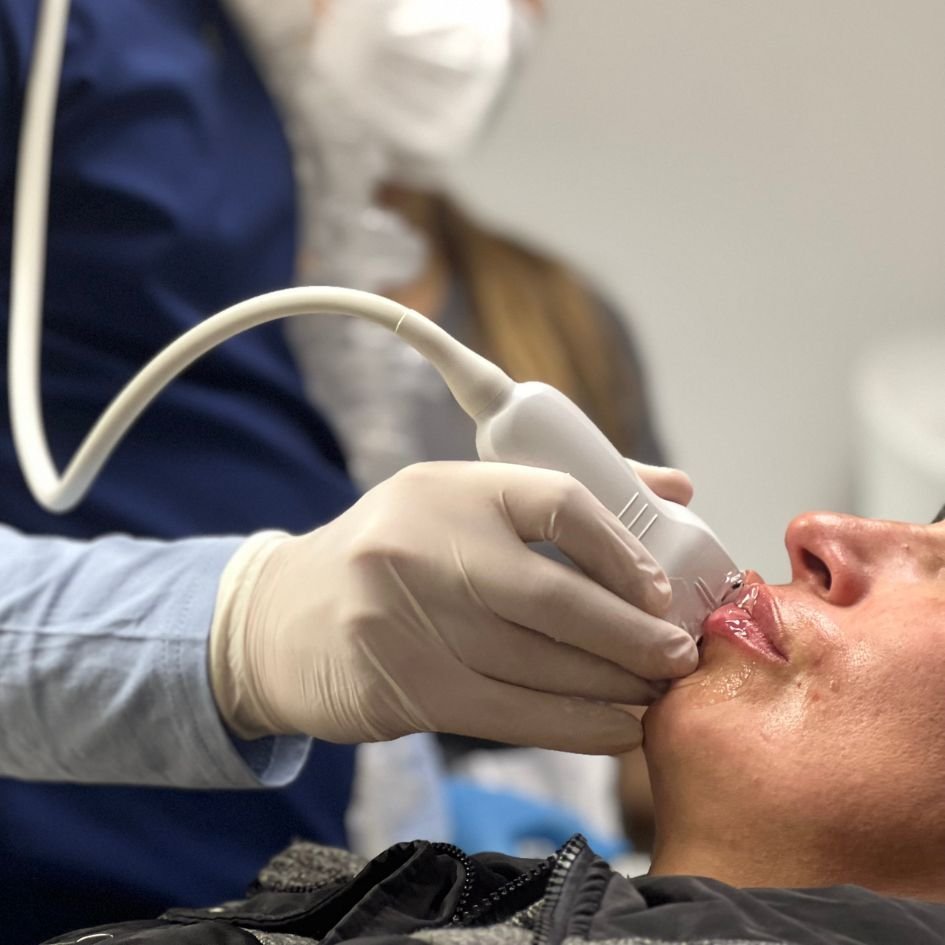
Hyaluronidase is the enzyme that breaks down hyaluronic acid fillers. It is a powerful tool, yet it is not a magic eraser. Used without an image of the tissue, it can remove too much, too little, or the wrong area entirely. In my practice I use high-frequency ultrasound before any dissolving injection. Seeing the filler first is what turns a blind correction into a precise one.
What hyaluronidase is and how it works
Hyaluronidase is an enzyme that degrades hyaluronic acid, the gel-like substance used in most modern dermal fillers. When injected into a deposit of filler, it cleaves the long sugar chains so the body can absorb them over the following days. This means it works on hyaluronic acid fillers — the most common type — but it does not work on every injectable.
The enzyme acts locally. It does not travel through the body, and it does not affect tissue that has not been injected with hyaluronic acid. Once injected into the targeted area, it begins breaking down the filler within hours. The result is a visible reduction in volume, but the full effect can take several days to settle, depending on how much product was present, how dense it is, and how deep it was placed.
This is why hyaluronidase is not a “one-shot fix.” It is a controlled correction. The goal is not to erase everything — it is to remove what should not be there while preserving what the patient actually needs. That requires precision, and precision requires seeing the tissue before acting.
What hyaluronidase dissolves — and what it does not
Hyaluronidase is not a universal solvent. It works on hyaluronic acid fillers, but many other injectables will not respond. Knowing the type of product under the skin is therefore the first step before any dissolving attempt.
Products that respond to hyaluronidase:
- Hyaluronic acid fillers (Restylane, Juvederm, Belotero, Teosyal, and similar)
- These are the most common facial fillers, and they can be reversed with the enzyme when medically indicated.
Products that do NOT respond to hyaluronidase:
- Calcium hydroxylapatite (Radiesse) is not dissolved by hyaluronidase. It is a different material that the body breaks down over months to years.
- Poly-L-lactic acid (Sculptra) is a biostimulator, not a filler in the same sense. It stimulates collagen production over time and does not dissolve with this enzyme.
- PMMA (Bellafill) and polyalkylimide are permanent or semi-permanent implants that hyaluronidase cannot break down.
- Silicone and biopolymers are not affected and require a completely different approach, often surgical.
This distinction matters because attempting to dissolve a non-hyaluronic acid product can make the problem worse. Injecting hyaluronidase into a scarred, inflamed, or infected area with no free product can spread inflammation, waste the enzyme, and delay the correct treatment. Patients do not always remember the brand or substance they received, and ultrasound can often identify the material by its echo pattern before any decision is made (Tang Y et al., 2026).
Why knowing what product you have matters
A common situation in my practice: a patient arrives with a lump, an uneven result, or a shadow under the eyes. They say “it was a filler,” but they do not know which one. They may have had it done years ago, abroad, or by someone who did not explain what was being used. In some cases, they were told it was hyaluronic acid, but the pattern on ultrasound suggests something else — older scar tissue, silicone, or a permanent filler that cannot be reversed.
Without knowing what is under the skin, dissolving is a gamble. If the product is not hyaluronic acid, hyaluronidase will not work. If it is scar tissue, the problem is not excess volume but fibrosis, and the treatment is different. If it is silicone or biopolymers, the approach may involve anti-inflammatory medication, surgery, or long-term monitoring rather than an enzyme injection.
This is why I do not treat “filler problems” blindly. The first step is not another injection — it is a diagnosis. And the fastest, most reliable way to get that diagnosis is high-frequency ultrasound.
The ultrasound difference: seeing before dissolving
The difference between dissolving what is left and dissolving everything is knowing exactly where the product is. Without an image, the injector relies on touch and guesswork. That works for obvious superficial lumps, but it fails when filler has migrated along tissue planes, sits near a vessel, or is layered with scar tissue.
High-frequency ultrasound shows:
- The exact plane where the filler sits — superficial, mid, or deep.
- The amount left and how it is distributed, including hidden pockets that touch cannot feel.
- The vessels around it, including compressed or partially blocked ones.
- The filler type, because different materials have distinct ultrasound signatures.
In a recent case series of vascular adverse events after filler, ultrasound-guided hyaluronidase allowed clinicians to place the enzyme precisely at the occlusion site with lower total doses and better tissue recovery than blind injection (Sigrist R et al., 2026). When vision is restored, the correction is no longer a gamble.
This is especially important around the eyes, nose, and lips, where arteries are small and close to the surface. A wrongly placed dissolving injection can remove support that the patient actually needs, or miss a pocket of product that is causing the problem. Ultrasound turns hyaluronidase from a blunt instrument into a targeted one.
01 Locating the product
The first role of ultrasound is to map the problem. It shows where the filler is, how much is left, and whether it is in a single pocket or spread across multiple planes. This prevents two common mistakes: dissolving too little (because the injector missed a pocket) and dissolving too much (because the injector overestimated the volume).
02 Planning the dose
Hyaluronidase is not “more is better.” Too much can remove volume the patient wants to keep; too little can leave a partial result. Ultrasound allows me to estimate the amount of product and plan the dose accordingly. In some cases, a staged approach is safer — a small initial dose, reassessment, then a second session if needed.
03 Monitoring the result
After dissolving, ultrasound can confirm that the product is gone and that the tissue is healing as expected. This is particularly useful when the problem was a migrated filler or a vascular complication. Seeing the result — rather than guessing — reduces the chance of over- or under-correction and helps plan the next step.
When dissolving is not the right choice
Not every bad filler result should be dissolved. Sometimes the better plan is to add a small amount of product in the right place, massage and wait for swelling to settle, or simply leave it alone if it is improving on its own.
I tend to avoid dissolving when:
- The issue is mainly swelling from a recent injection, which usually resolves in one to two weeks.
- The filler is old scarred tissue rather than free product.
- The patient wants a minor adjustment and a small addition would give a better shape.
- The product is not hyaluronic acid and hyaluronidase would not help.
- There is an active infection or inflammatory nodule that needs medical treatment first.
A careful assessment also prevents what I call “over-dissolving”: removing so much volume that the face looks hollow or aged. Once the filler is gone, replacing it requires a new procedure, so the decision should be deliberate. Dissolving is a medical intervention, not an undo button.
What to expect during and after the injection
After the ultrasound map is complete, a tiny amount of hyaluronidase is injected into the targeted deposit. The enzyme starts working within hours, and most patients see a visible reduction within 24 to 48 hours. Some areas need a second session one to two weeks later, especially if the product is dense, layered, or placed deep.
Swelling and redness are common the same day. Bruising can occur if a vessel is touched. The area may look softer or flatter almost immediately, but the final result is judged after one to two weeks, once the enzyme has finished acting and any swelling has settled.
For vascular emergencies — sudden pain, skin turning pale or blotchy, vision changes — hyaluronidase is used urgently and in higher doses, guided by ultrasound when possible. A case of infraorbital artery occlusion with secondary gum ischemia was resolved with ultrasound-guided low-dose hyaluronidase because the team could see the vessel and deliver the enzyme exactly where it was needed (Barber-Garcia C et al., 2026).
Risks and how they are managed
Hyaluronidase is generally safe, but it has risks:
- Allergic reaction: Rare, but possible. A skin test may be done if there is a history of allergy to bee or wasp stings, or prior reaction to hyaluronidase.
- Over-correction: Removing too much volume, leaving a depression or loose skin.
- Under-correction: Needing more than one session.
- Skin texture changes: Temporary unevenness as the product breaks down.
- Injection site reactions: Swelling, redness, bruising, or tenderness that usually resolve in days.
The best way to reduce all of these risks is to start with an ultrasound image and use the smallest effective dose. In my experience, precision beats volume every time. A single targeted injection is safer than multiple blind attempts.
Aftercare and follow-up
After the injection, the area should be treated gently. No massage, no pressure, no heat or intense exercise for 24 to 48 hours. Swelling and mild discomfort are normal and should improve day by day. If pain increases, if the skin changes color, or if vision is affected, contact me immediately — those are not normal recovery signs.
A follow-up appointment is usually scheduled one to two weeks after the injection. At that point, we review the result and decide whether a second session is needed. If the goal is to re-fill the area later, I usually recommend waiting at least two weeks to let the tissue settle and to confirm that no residual product is causing unevenness.
Cost of filler correction with hyaluronidase
The cost of hyaluronidase treatment depends on several factors: how much product needs to be dissolved, how many areas are involved, whether a second session is needed, and whether the case is a routine correction or a vascular emergency. A simple lip adjustment is not the same as a complex, multi-layered correction with ultrasound mapping.
Because of this, I do not quote prices without first seeing the case. During the consultation, I review the area with ultrasound, explain the plan, and provide a clear estimate before any procedure. For patients traveling from abroad, we can start with an online assessment and schedule the correction during your visit to Cartagena.
Hyaluronidase in Cartagena with Dr. Jorge Vives
My approach to filler correction is based on two principles: diagnosis before treatment, and precision over volume. As a radiologist and aesthetic physician, I use high-frequency ultrasound to see the tissue before deciding what to do. This allows me to distinguish between excess filler, scar tissue, silicone, or other materials — and to treat each case with the right strategy, not just the most common one.
I perform these procedures in my clinic in Bocagrande, Cartagena, with patients from Colombia and abroad. The consultation includes a full assessment, ultrasound when indicated, and a clear explanation of what can — and cannot — be corrected. My goal is not to sell a procedure; it is to solve the problem with a safe and precise method.
If you are unhappy with a filler result, the first step is not another injection — it is a diagnosis. At my practice in Cartagena I use ultrasound to locate the product and decide whether hyaluronidase, a small adjustment, or simply waiting is the right plan. You can book an ultrasound assessment here. For patients traveling from abroad, we also schedule online consultations before your trip.
Book an assessmentFrequently asked questions
Can all fillers be dissolved with hyaluronidase?
No. Only hyaluronic acid fillers respond. Calcium hydroxylapatite, poly-L-lactic acid, PMMA, and silicone require different strategies, and some cannot be dissolved at all. Ultrasound can help identify the product before deciding.
How long does it take to see results?
Most patients notice a change within 24 to 48 hours. Dense or deep product may take one to two weeks, and a second session is sometimes needed. The final result is judged after the swelling has settled.
Is dissolving filler painful?
The injection itself feels like a small pinch. We use topical anesthesia and very fine needles. Discomfort is usually mild and short-lived.
Can hyaluronidase damage my own tissue?
Hyaluronidase also breaks down the body's own hyaluronic acid, but this is temporary. Normal tissue hydration returns within days to weeks. The enzyme does not cause permanent damage when used correctly.
Should I dissolve or just add more filler?
It depends on the problem. If the product is in the wrong place, dissolving is often better. If the shape is slightly off, a small addition may be enough. The ultrasound assessment decides which approach is safer and more effective.
What is a vascular emergency after filler?
Severe pain, skin blanching or discoloration, and any visual disturbance are emergency signs. They require immediate medical attention and high-dose hyaluronidase, guided by ultrasound when possible.
Can I get filler again after dissolving?
Yes, but it is usually better to wait at least two weeks. This allows the tissue to settle, confirms that the previous product is gone, and reduces the risk of unevenness or overcorrection in the new treatment.
Do I need to see a radiologist for this?
Not every injector needs to be a radiologist, but having one who uses ultrasound changes the safety and precision of the procedure. In my practice, ultrasound is not an add-on — it is part of how I plan and execute the correction.
About the reviewer
Reviewed by: Dr. Jorge Vives Gutiérrez
Specialty: Radiologist and Aesthetic Physician
Education: Universidad de Cartagena, Colombia
Affiliations: Asociación Colombiana de Radiología (ACR), CMAC Iberoamérica, AAAM
References
- Tang Y, Wang Z, Bi M, Jia Y. Clinical Applications of High-Frequency Ultrasound in Filler Identification and Complication Management. *Seminars in Ultrasound, CT, and MR*. 2026;47(3):331-345. https://pubmed.ncbi.nlm.nih.gov/42342087/
- Sigrist RMS, Gonzalez C, Schelke L, Wortsman X, Desyatnikova S. Doppler Ultrasound Findings in Filler-Related Facial Vascular Adverse Events: An International Multicenter Study. *Diagnostics (Basel)*. 2026;16(10):1789. https://pubmed.ncbi.nlm.nih.gov/42279455/
- Barber-García C, Nevado-Sánchez E, Núñez-Rodríguez S, Cavadas A, Bueno-de la Fuente A. Ultrasound-Guided Low-Dose Hyaluronidase for Infraorbital Artery Occlusion with Secondary Gingival Ischemia After Hyaluronic Acid Filler Injection: A Case Report. *Diagnostics (Basel)*. 2026;16(12):2114. https://pubmed.ncbi.nlm.nih.gov/42449755/